
Scholarly Output
This page brings together the emerging scholarly contributions of this research project. Here you will find research briefs, descriptions of scholarly presentations, and links to peer‑reviewed journal articles that extend and deepen the project’s central questions, methods, and findings. They are intended to speak to multiple audiences, including researchers, educators, community partners, and policymakers, and to contribute to conversations across disciplines. This is a work in progress. As the project continues to evolve, additional scholarly outputs—including new publications, conference presentations, and knowledge mobilization materials—will be added. We invite you to return to this page as the body of scholarship grows and develops over time.
Production scientifique
Cette page rassemble les contributions scientifiques émergentes de ce projet de recherche. Vous y trouverez des synthèses de recherche, des descriptions de présentations scientifiques et des liens vers des articles de revues à comité de lecture qui approfondissent et développent les questions centrales, les méthodes et les résultats du projet. Ces ressources sont destinées à un large public, notamment les chercheurs, les enseignants, les partenaires communautaires et les décideurs politiques, et visent à enrichir les échanges interdisciplinaires. Ce travail est en cours. À mesure que le projet évolue, de nouvelles publications, des communications lors de conférences et des outils de mobilisation des connaissances y seront ajoutés. Nous vous invitons à consulter régulièrement cette page pour suivre l'évolution de la documentation.

JOURNAL ARTICLES / ARTICLES DE REVUES SCIENTIFIQUES
Howard, P.S.S. & Tecle, S. (2025). Involving humans, or Doing Good Work with Good People: Insights for Qualitative Research in Black Studies post-2020. International Review of Qualitative Research, 18(4), 367-389, DOI:10.1177/19408447251334610
This article engages the work of Caribbean theorist Sylvia Wynter—particularly her 1994 article, “No Humans Involved.” We examine the unprecedented post-2020 climate of invitation and recognition of Black scholars, Black research, “Black excellence,” and Black Studies in the Canadian academy and inquire into its implications for research methodologies. We identify the current Canadian academic climate, like those that Wynter examines in her work, as emerging in the aftermath of Black death, anti-Black terror, and race rebellion. We argue that despite the ostensible epiphanies that this moment might be taken to represent, the anti-Black ordering of bodies and knowledge that Wynter outlines might well persist in the Canadian academy embedded in methodologies that produce Black people as non-human. We take seriously the possibility that the new discourses of recognition, invitation, excellence, and incorporation might be the new strategies by which BlackLife is cast beyond the realm of the Human in Canadian universities. As Wynter proffered for Black Studies, we argue that Black research cannot leave the university or its methods intact as it enters the university. We reflect on ways forward for Black researchers that insist on Black humanity in a university context that routinely denies it.
CONFERENCE PAPERS / COMMUNICATIONS SCIENTIFIQUES.
Howard, P.S.S., Johnson, B.C.Y., Davy, R, Dikaczova, L., Hinkson, S., & Jaquemet, S. (2026) “The Funding is Not Necessarily Helping, Although it’s Necessary”: The Politics of Funding for Black Community Supplementary Education Organizations in Montreal. Paper presented at the annual meeting of the Canadian Society for the Study of Education (CSSE: CASJE- ACÉJS) University of Winnipeg, Winnipeg, MB. June 2.
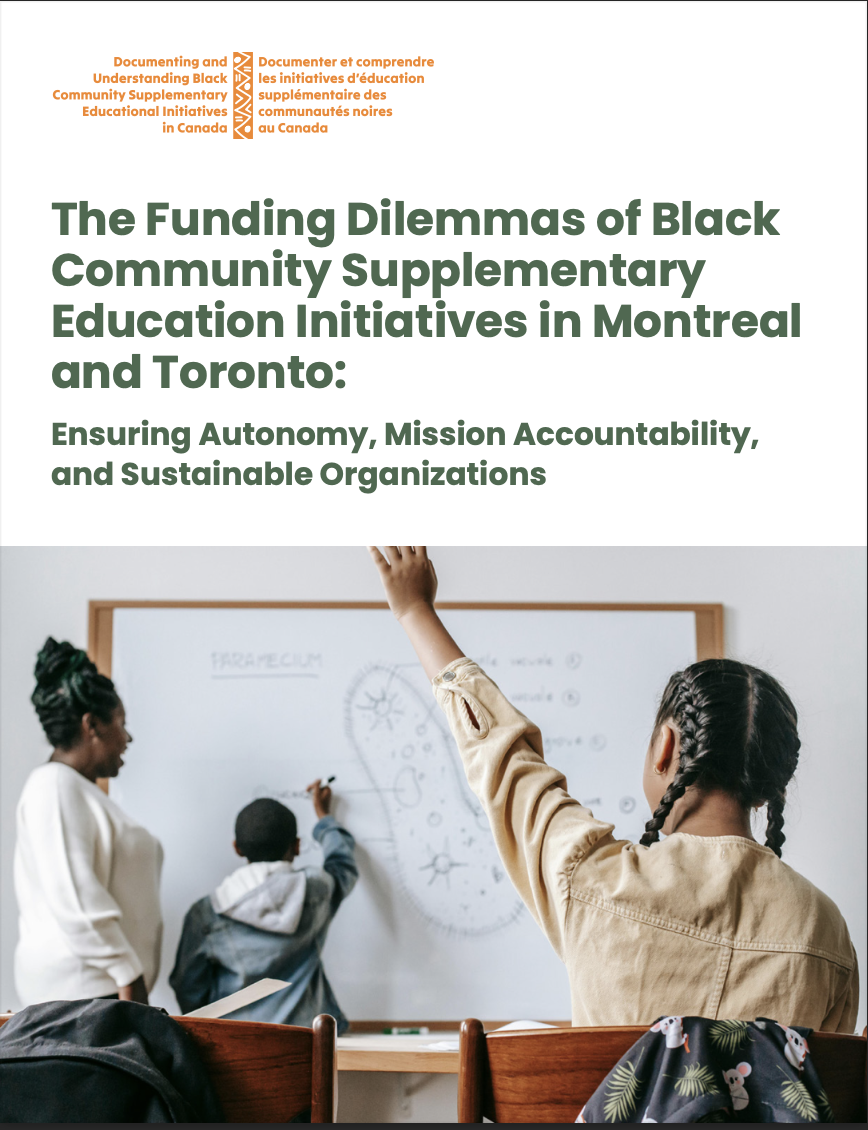
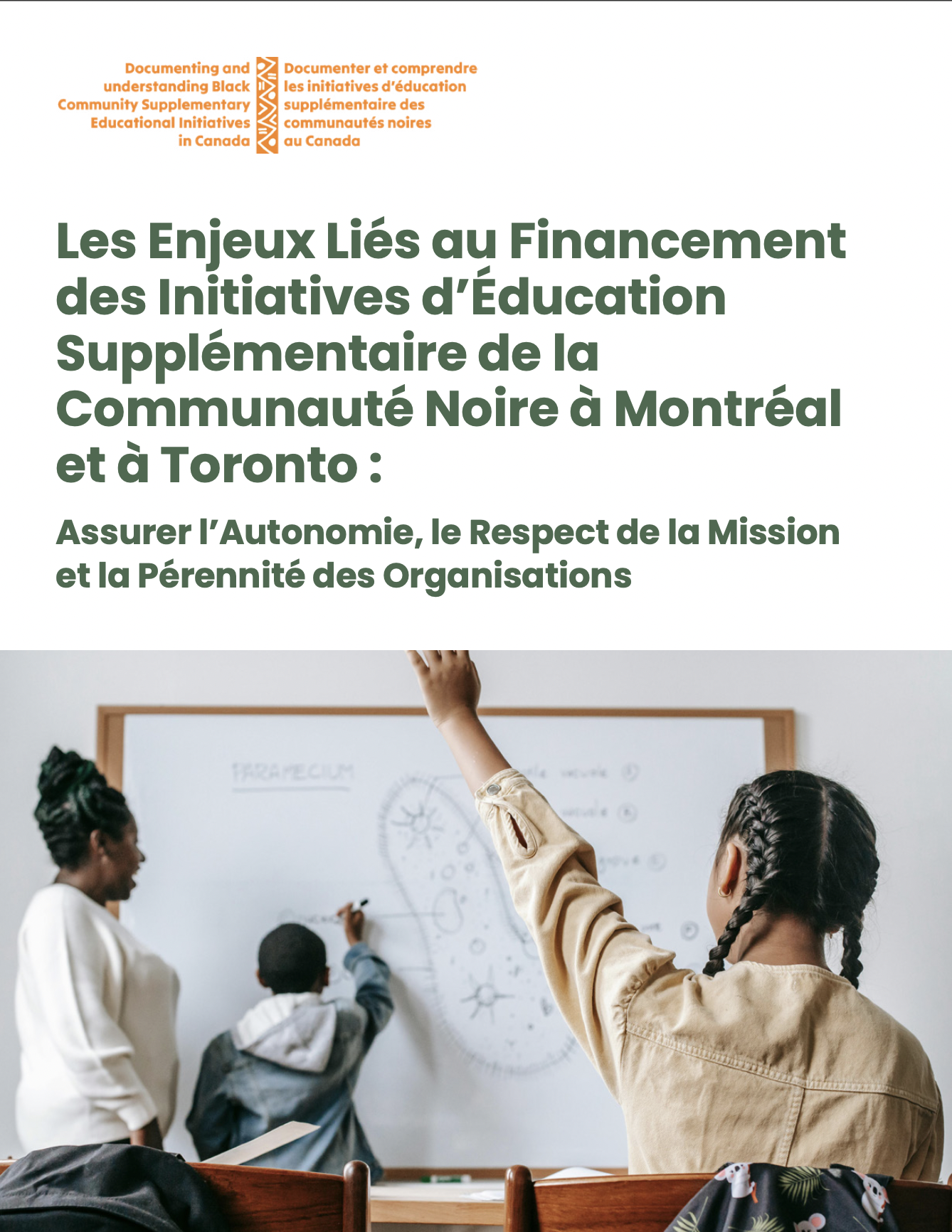
This presentation discusses the vagaries of funding for BCSEs. BCSEs require funding to run their programs and accomplish their missions, and they largely draw on non-Black government funding sources. Yet, our preliminary findings suggest that BCSEs’ dependence on external funding shapes the work of these organizations in at least three harmful ways: i) by producing mission creep, whereby organizations tailor their programs to fit funders’ priorities in ways that subordinate their own priorities; ii) by creating pressure to serve a broader clientele because of multiculturalizing demands BCSEs anticipate from mainstream funders and/or because of the diminishing Black anglophone population in Quebec (in the case of anglophone organizations); and iii) by generating counterproductive competition between BCSEs. This situation presents a tension for BCSEs, whereby, at the extremes, they might either accept funding but risk diluting their missions, or reject funding to maintain their priorities but have less financial capacity to accomplish them. Nevertheless, BCSEs do not necessarily submit to the antiblackness that gives rise to this polarizing dynamic, and this presentation also addresses the ways in which BCSEs navigate the tension and make ways for Black life and Black organizing in the pervasive climate of antiblackness
Howard, P.S.S. (2025). The Politics of Black Community Supplementary Education Initiatives in a Canadian City. Paper presented at the annual meeting of the Canadian Society for the Study of Education (CSSE-CAFÉ), at the Congress of the Humanities and Social Sciences, Toronto, ON. June 3
Using a Black Studies theoretical framework and a methodology that incudes Critical Discourse Analysis and Critical Race Counterstory this paper considers the fugitive, sometimes contradictory, discursive formations through which BCSE leaders in a small Canadian city, understand their BCSE initiatives. I explore how participants’ narratives embrace both Black liberal and radical imaginations, while also weaving in and out of dominant readings of gender and of Black students’ realities, and constructing subjectivities against longer-standing Black communities in nearby megacities. The paper offers insights on what it means to support Black students through interventions outside, or in the undercommons of, the antiblack Canadian nation-state and its institutions.
Lewis, L.D. & Howard, P.S.S. (2023). The Negro Community Centre School Lunch Program in Montreal, 1955-1981: Lessons in Black community organizing. Paper presented at the annual meeting of the Black Canadian Studies Association, at the Congress of the Humanities and Social Sciences, York University, Toronto, ON. May 29-31.
The Negro Community Centre (NCC) was founded in 1927, in Montreal, Quebec to address the conditions of Black people living in Montreal. In 1949, the NCC registered with the Social Welfare department of the city of Montreal and received funding through its membership with United Red Feather Associations, which would itself evolve into what is known today as Centraide. In 1955, the NCC inherited the School Lunch Program (SLP) which it ran for 26 years until 1981, and which is the subject of this presentation. We are interested in the social implications for Montreal Black communities of the SLP, given the complex social relations informing the constitution, governance and funding of the NCC.
Using the operation of the NCC school lunch program as a case study, this presentation based on research in the NCC archives examines the key players involved in the lunch program of the NCC in Montreal from 1955-1981. These players included Montreal elite who belonged to social clubs, the federal government, and much later on the Protestant School Board of Greater Montreal. We identify the dominant narratives that were embedded in the relationships between the NCC and these players and the operation of the SLP. We also use the archival data to trace the ways in which the structure and composition of the NCC board and management impacted the SLP sometimes reproducing troubling class and gender dynamics. We end by considering how the lessons of the operation of this NCC lunch program might be relevant to Black community organizing today.
Howard, P.S.S., Cattani-Perroni, T., & Kidd, T.J. (2022). Naming What’s Wrong, Making it Right: A preliminary inventory of Black Community Supplementary Education Initiatives in Montreal. Paper presented at the annual meeting of the Black Canadian Studies Association, at the Congress of the Humanities and Social Sciences (virtual conference). May 15.
While BCSAs exist, and have existed historically, across Britain, the United States, and Canada, it would be a mistake to imagine that they have been monolithic in their visions and purpose. This paper reports on a range of approaches among Montreal BCSEs that we have identified through interviews with BCSE organizers. We use a Black radical thought framework to present a sampling of these approaches–which we find to exist on a spectrum from more liberal to more radical assumptions about the relationship between Blackness and state education. We argue that the politics undergirding BCSE approaches cannot always be attributed to the attitudes of the BCSE members but rather are informed and produced by the state itself–largely through funding mechanisms.
How to cite: Howard, P. S. S., Lewis, L. D., Tecle, S., Lawson, E. S. & Saney, I. (2025). Scholarly Output. Documenting and understanding Black Community Supplementary Educational Initiatives in Canada (Research Project Website)
Comment citer: Howard, P. S. S., Lewis, L. D., Tecle, S., Lawson, E. S. et Saney, I. (2025). [Production scientifique]. Documenter et comprendre les initiatives d’éducation supplémentaire des communautés noires au Canada (Site Web du projet de recherche)